220
00DH
300.00 DH
-27%
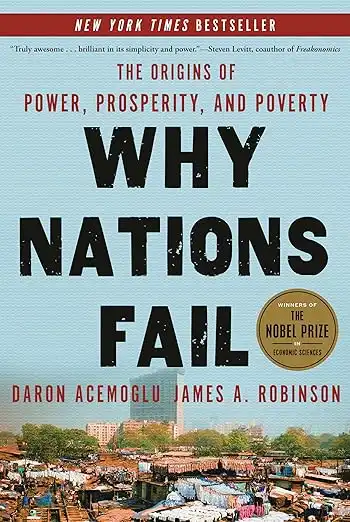
Why Nations Fail: The Origins of Power, Prosperity, and Poverty
Livraison
DétailsFrais de livraison à partir de :
Livraison entre le Samedi 6 juin 2026 et le Lundi 8 juin 2026
À propos de cet article :
Marque : GENERIC
Vendu par HEAVENBOOKS.MA
NEW YORK TIMES AND WALL STREET JOURNAL BESTSELLER • From two winners of the 2024 Nobel Prize in Economic Sciences, “who have demonstrated the importance of societal institutions for a country’s prosperity”“A wildly ambitious work that hopscotches through history and around the world to answer the very big question of why some countries get rich and...
Partagez ce produit
1
Mode de paiement
Paiement par carte bancaire
Carte marocaines
Paiement à la livraison
Paiement en espèce à la livraison
Politique de retours
Note de politique de retour
 Produits 100% authentiques
 Livraison partout au Maroc
 Satisfait ou remboursé
 Offre nationale et internationale
Description produit
Marque
GENERIC
Titre principal
Why Nations Fail: The Origins of Power, Prosperity, and Poverty
Editeur
Crown Currency
Type de produit
Paperback
Présentation du livre
Paperback
Release date
9/17/2013 12:00:00 AM
Langue d'origine
English
ISBN
307719227
Dimensions
5.17 x 1.25 x 8 inches
Nombre de pages de livre
544 pages
Langue - Librairie
English
Résumé
NEW YORK TIMES AND WALL STREET JOURNAL BESTSELLER • From two winners of the 2024 Nobel Prize in Economic Sciences, “who have demonstrated the importance of societal institutions for a country’s prosperity”“A wildly ambitious work that hopscotches through history and around the world to answer the very big question of why some countries get rich and others don’t.”—The New York TimesFINALIST: Financial Times and Goldman Sachs Business Book of the Year Award • ONE OF THE BEST BOOKS OF THE YEAR: The Washington Post, Financial Times, The Economist, BusinessWeek, Bloomberg, The Christian Science Monitor, The Plain DealerWhy are some nations rich and others poor, divided by wealth and poverty, health and sickness, food and famine? Is it culture, the weather, or geography that determines prosperity or poverty? As Why Nations Fail shows, none of these factors is either definitive or destiny. Drawing on fifteen years of original research, Daron Acemoglu and James Robinson conclusively show that it is our man-made political and economic institutions that underlie economic success (or the lack of it). Korea, to take just one example, is a remarkably homogenous nation, yet the people of North Korea are among the poorest on earth while their brothers and sisters in South Korea are among the richest. The differences between the Koreas is due to the politics that created those two different institutional trajectories. Acemoglu and Robinson marshal extraordinary historical evidence from the Roman Empire, the Mayan city-states, the Soviet Union, the United States, and Africa to build a new theory of political economy with great relevance for the big questions of today, among them: • Will China’s economy continue to grow at such a high speed and ultimately overwhelm the West? • Are America’s best days behind it? Are we creating a vicious cycle that enriches and empowers a small minority?“This book will change the way people think about the wealth and poverty of nations . . . as ambiti
Auteur(s)
Daron Acemoglu, James A. Robinson
Date de parution
9/17/2013 12:00:00 AM